
Tuesday, March 24, 2020

Why the Stock Market Correction Probably Won’t Impact Home Values


Why the Stock Market Correction Probably Won’t Impact Home Values | MyKCM

With the housing crash of 2006-2008 still visible in the rear-view mirror, many are concerned the current correction in the stock market is a sign that home values are also about to tumble. What’s taking place today, however, is nothing like what happened the last time. The S&P 500 did fall by over fifty percent from October 2007 to March 2009, and home values did depreciate in 2007, 2008, and 2009 – but that was because that economic slowdown was mainly caused by a collapsing real estate market and a meltdown in the mortgage market.
This time, the stock market correction is being caused by an outside event (the coronavirus) with no connection to the housing industry. Many experts are saying the current situation is much more reminiscent of the challenges we had when the dot.com crash was immediately followed by 9/11. As an example, David Rosenberg, Chief Economist with Gluskin Sheff + Associates Inc., recently explained:
“What 9/11 has in common with what is happening today is that this shock has also generated fear, angst and anxiety among the general public. People avoided crowds then as they believed another terrorist attack was coming and are acting the same today to avoid getting sick. The same parts of the economy are under pressure ─ airlines, leisure, hospitality, restaurants, entertainment ─ consumer discretionary services in general.”
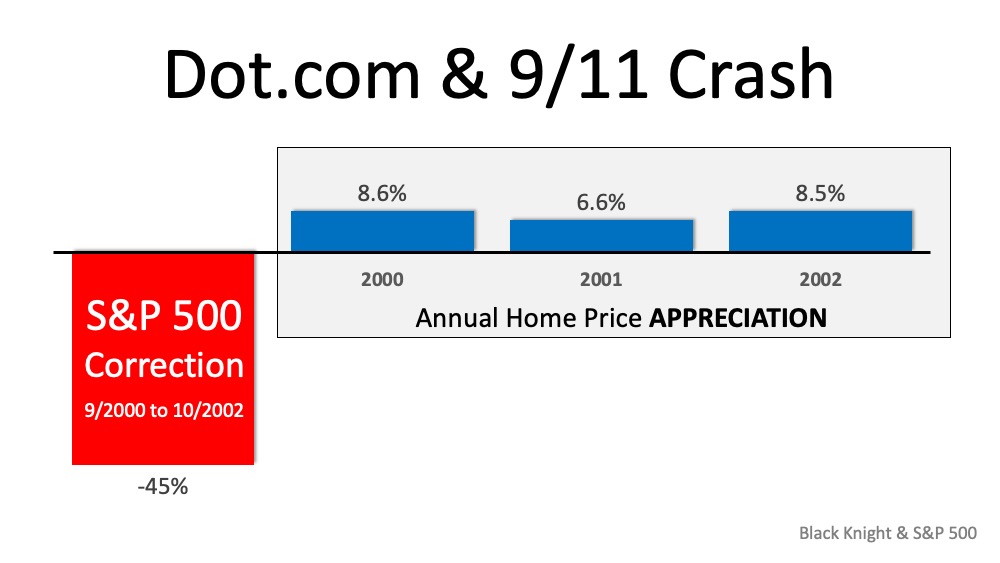
Since the current situation resembles the stock market correction in the early 2000s, let’s review what happened to home values during that time.Why the Stock Market Correction Probably Won’t Impact Home Values | MyKCMThe S&P dropped 45% between September 2000 and October 2002. Home prices, on the other hand, appreciated nicely at the same time. That stock market correction proved not to have any negative impact on home values.
Bottom Line

If the current situation is more like the markets in the early 2000s versus the markets during the Great Recession, home values should be minimally affected, if at all.


Monday, March 9, 2020

Does “Aging in Place” Make the Most Sense?


Does “Aging in Place” Make the Most Sense? | MyKCM

A desire among many seniors is to “age in place.” According to the Senior Resource Guide, the term means,
“…that you will be remaining in your own home for the later years of your life; not moving into a smaller home, assisted living, or a retirement community etcetera.”
There is no doubt about it – there’s a comfort in staying in a home you’ve lived in for many years instead of moving to a totally new or unfamiliar environment. There is, however, new information that suggests this might not be the best option for everyone. The familiarity of your current home is the pro of aging in place, but the potential financial drawbacks to remodeling or renovating might actually be more costly than the long-term benefits.
A recent report from the Joint Center for Housing Studies of Harvard University (JCHS) titled Housing America’s Older Adults explained,
“Given their high homeownership rates, most older adults live in single-family homes. Of the 24 million homeowners age 65 and over, fully 80 percent lived in detached single-family units...The majority of these homes are now at least 40 years old and therefore may present maintenance challenges for their owners.”
If you’re in this spot, 40 years ago you may have had a growing family. For that reason, you probably purchased a 4-bedroom Colonial on a large piece of property in a child-friendly neighborhood. It was a great choice for your family, and you still love that home.
Today, your kids are likely grown and moved out, so you don’t need all of those bedrooms. Yard upkeep is probably very time consuming, too. You might be thinking about taking some equity out of your house and converting one of your bedrooms into a massive master bathroom, and maybe another room into an open-space reading nook. You might also be thinking about cutting back on lawn maintenance by installing a pool surrounded by beautiful paving stones.
It all sounds wonderful, doesn’t it? For the short term, you may really enjoy the new upgrades, but you’ll still have to climb those stairs, pay to heat and cool a home that’s larger than what you need, and continue fixing all the things that start to go wrong with a 40-year-old home.
Last month, in their Retirement Report, Kiplinger addressed the point,
“Renovations are just a part of what you need to make aging in place work for you. While it’s typically less expensive to remain in your home than to pay for assisted living, that doesn’t mean it’s a slam dunk to stay put. You’ll still have a long to-do list. Just one example: You need to plan ahead for how you will manage maintenance and care—for your home, and for yourself.”
So, at some point, the time may come when you decide to sell this house anyway. That can pose a big challenge if you’ve already taken cash value out of your home and used it to do the type of remodeling we mentioned above. Realistically, you may have inadvertently lowered the value of your home by doing things like reducing the number of bedrooms. The family moving into your neighborhood is probably similar to what your family was 40 years ago. They probably have young children, need the extra bedrooms, and may be nervous about the pool.

Bottom Line

Before you spend the money to remodel or renovate your current house so you can age in place, let’s get together to determine if it is truly your best option. Making a move to a smaller home in the neighborhood might make the most sense.

Friday, February 14, 2020

How to Avoid a Gender Gap When Investing in the Housing Market


How to Avoid a Gender Gap When Investing in the Housing Market | MyKCM

When buying a home, we all want to feel like we’re making the right decision, paying a fair price, and making the best investment of our lives. According to a recent gender-based study, men and women can unknowingly walk away with very different financial outcomes when the deal closes. Thankfully, if you follow some simple ways to arm yourself with the information you need to prepare in advance, you’re more likely to feel like you’ve won when the keys to your new house are in your pocket.
Kelly Shue and Paul Goldsmith-Pinkham of the Yale School of Management showed in their recent study The Gender Gap in Housing Returns, when single women invest in the housing market, they’re generally losing out compared to their male counterparts. The report explains,
“We find that single men earn one percentage point higher unlevered returns per year on housing investment relative to single women...The gender gap grows significantly larger after adjusting for mortgage borrowing: men earn 6 percentage points higher levered returns per year relative to women. Data on repeat sales reveal that women buy the same property for approximately 2% more and sell for 2% less.”
On National Public Radio (NPR), Kelly Shue elaborated by saying,
“Women are losing about $1,370 per year relative to men because they tend to buy the same house at a higher price and sell for a lower price.”
In the grand scheme of things, $1,370 a year could be as much as an entire month’s mortgage payment for many households in the United States.

How can you make sure this doesn’t happen to you?

The good news is, it doesn’t have to be this way for anyone, regardless of gender. Here are a few tips on how to make sure you’re prepped and ready to enter the housing market with your best foot forward.
1. Work with a Trusted Real Estate Professional
You need someone on your side who’s going to have your best interest in mind and support your unique homeownership goals. Hiring an agent who has a finger on the pulse of the market will make your buying experience an educated one. You need someone who’s going to tell you the truth, not just what they think you want to hear.
2. Understand the Homebuying Process
Know the key homebuying steps in advance, so you have the best context for how the process works from pre-approval to budgeting, inspections, and more. Have a price range in mind that you can realistically afford, too, so you’re ready to make an offer that positions you for success. Ask your agent questions along the way, and partner together so you feel confident and prepared at every turn.
3. Research the Current Market
Make sure you know the current trends and insights of the housing market as well. When you find a home that’s the perfect fit, determine what other homes are selling for in the neighborhood. These numbers can vary over time based on market conditions such as inventory, appreciation, and many other economic factors. A great agent will provide you with this information and guide you through every step from start to finish.

Bottom Line

When you have a trusted advisor on your side and you’re confident you know exactly what’s happening in the market, you’ll be in a great position to negotiate effectively. Let’s get together today to make sure you’re ready to win the homebuying deal.