
Wednesday, November 20, 2019

Forget the Price of the Home. The Cost is What Matters.


Forget the Price of the Home. The Cost is What Matters. | MyKCM

Home buying activity (demand) is up, and the number of available listings (supply) is down. When demand outpaces supply, prices appreciate. That’s why firms are beginning to increase their projections for home price appreciation going forward. As an example, CoreLogic increased their 12-month projection for home values from 4.5% to 5.6% over the last few months.
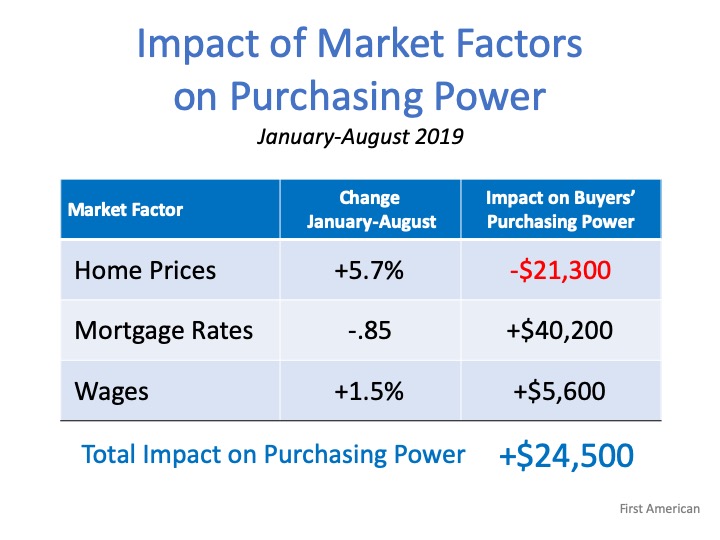
The reacceleration of home values will cause some to again voice concerns about affordability. Just last week, however, First American came out with a data analysis that explains how price is not the only market factor that impacts affordability. They studied prices, mortgage rates, and wages from January through August of this year. Here are their findings:

Home Prices

“In January 2019, a family with the median household income in the U.S. could afford to buy a $373,900 house. By August, that home had appreciated to $395,000, an increase of $21,100.”

Mortgage Interest Rates

“The 0.85 percentage point drop in mortgage rates from January 2019 through August 2019 increased affordability by 9.7%. That translates to a $40,200 improvement in house-buying power in just eight months.”

Wage Growth

“As rates have fallen in 2019, the economy has continued to perform well also, resulting in a tight labor market and wage growth. Wage growth pushes household incomes upward, which were 1.5% higher in August compared with January. The growth in household income increased consumer house-buying power by 1.5%, pushing house-buying power up an additional $5,600.”
When all three market factors are combined, purchasing power increased by $24,500, thus making home buying more affordable, not less affordable. Here is a table that simply shows the data:Forget the Price of the Home. The Cost is What Matters. |  MyKCM
Bottom Line

In the article, Mark Fleming, Chief Economist at First American, explained it best:
“Focusing on nominal house price changes alone as an indication of changing affordability, or even the relationship between nominal house price growth and income growth, overlooks what matters more to potential buyers – surging house-buying power driven by the dynamic duo of mortgage rates and income growth. And, we all know from experience, you buy what you can afford to pay per month.”


Sunday, November 10, 2019

Thinking of Selling Your Home? The Waiting Is The Hardest Part.


Thinking of Selling Your Home? The Waiting Is The Hardest Part. | MyKCM

Tom Petty famously penned the words, “the waiting is the hardest part” in his early 80’s hit song The Waiting, and his thought process can surprisingly also be applied to individuals considering selling their homes today. Traditional thinking would suggest it may be best to wait until the spring to sell when there is a flood of buyers in the market, but right now may in fact be an even better time to list your home.
We can see the overall economy is good: wages are rising, there are near record-low unemployment rates, and mortgage interest rates are still very low too. Over the past 10+ years the housing market has stabilized, so what (if anything) is the biggest challenge in the housing market today?
The answer is simple: it’s inventory.
According to the Existing Home Sales Report by the National Association of Realtors,
“Total housing inventory at the end of September sat at 1.83 million, approximately equal to the amount of existing-homes available for sale in August, but a 2.7% decrease from 1.88 million one year ago. Unsold inventory is at a 4.1-month supply at the current sales pace, up from 4.0 months in August and down from the 4.4-month figure recorded in September 2018.”

What does this mean?

While homes are coming to the market, they aren’t coming fast enough! Right now, across the country there is less than 6 months of overall inventory of homes for sale, putting us in a seller’s market. The challenge is that there are not enough homes for sale to increase the supply needed for the number of people who want to buy, especially in the starter and middle-level markets.
To be in a balanced market (meaning we have enough inventory for the number of buyers in the market), we need to have 6 months of inventory available. Today we are nowhere near that number, and as a matter of fact, the last time we reached that height was August 2012 (as shown in the graph below):Thinking of Selling Your Home? The Waiting Is The Hardest Part. | MyKCMWhen we look at the inventory challenge today, we can see that now is a great time to sell your house. Truthfully, waiting may end up being the hardest part in the long run. This landscape is a great place for sellers who own homes in the starter and middle-level markets to take the opportunity to sell in a sellers’ market, before inventory catches up with demand. Serious buyers are actively in the market and ready to make a move at this time of year. When inventory is limited at the lower end, like it is today, selling before more homes are listed could mean a significant seller’s advantage to those who are ready to move up. The upper level of the market has much more inventory available to move into, so it’s a win across the board.

Bottom  Line

If you’re considering selling your home, don’t wait – now is the time to make your move! Take advantage of the high housing demand and the low inventory of homes for sale at the lower end of the market and use your purchasing power while mortgage rates are low to go after the move-up home of your dreams. Let’s get together to decide if now is the right time for you.

Friday, November 8, 2019

Depending on the Price, You’re Going to Need Advice


Depending on the Price, You’re Going to Need Advice | MyKCM

To understand today’s complex real estate market, it is critical to have a local, trusted advisor on your side – for more reasons than you may think.
In real estate today, there are essentially three different price points in the market: the starter-home market, the middle-home market, and the premium or luxury market. Each one is unique, and depending on the city, the price point in these categories will vary. For example, a starter or lower-end home in San Francisco, California is much more expensive than almost any other part of the country. Let’s explore what you need to know about each of these tiers.
Starter-Home Market: This market varies by price, and these homes are typically purchased by first-time home buyers or investors looking to flip them for a profit. Across the country, homes in this space currently have less than 6 months of inventory for sale. That means there aren’t enough homes on the lower end of the market for the number of people who want to buy them. A low supply like this generally increases competition, drives bidding wars, and sets up an environment where homes sell above the listing price. According to data from the National Association of Realtors (NAR) on realtor.com,
“The desire for affordability continues to push down the inventory for homes listed for less than $200,000.00.”
Middle-Home Market: This segment is often thought of as the move-up market. Typically, the buyer in this market is moving up to a larger, more custom home with more features, all coming at a higher price. Across the country, this market is looking more balanced than the lower end of the market, meaning it has closer to a 6-month supply of inventory for sale. This market is more neutral, but leaning towards a seller’s market.
Premium & Luxury Home Market: This is the top end of the market with larger homes that have even more custom features and upgrades. Nationwide, this market is growing in the number of homes for sale. In the same realtor.com article, we can see that year-over-year inventory of homes in this tier has grown by 4.7%. Today, there are more homes available in the premium and luxury space, leading to more of a buyer’s market at this end.

Bottom Line

Depending on the segment of the market and the price point you’re looking at, you’re going to need the advice of a true local market expert. Let's get together to help you navigate the home-buying or selling process in your market.