I love articles like this. I want to know what the top colors and materials are!!
Friday, February 7, 2020

Thursday, February 6, 2020
Great News for Renters Who Want to Buy a Home

Rents in the United States have been skyrocketing since 2012. This has caused many renters to face a tremendous burden when juggling their housing expenses and the desire to save for a down payment at the same time. The recent stabilization of rental prices provides a great opportunity for renters to save more of their current income to put toward the purchase of a home.
Just last week the Joint Center of Housing Studies of Harvard University released the America's Rental Housing 2020 Report. The results explain the financial challenges renters are experiencing today,
“Despite slowing demand and the continued strength of new construction, rental markets in the U.S. remain extremely tight. Vacancy rates are at decades-long lows, pushing up rents far faster than incomes. Both the number and share of cost-burdened renters are again on the rise, especially among middle-income households.”
According to the most recent Zillow Rent Index, which measures the estimated market-rate rent for all homes and apartments, the typical U.S. rent now stands at $1,600 per month. Here is a graph of how the index’s median rent values have climbed over the last eight years: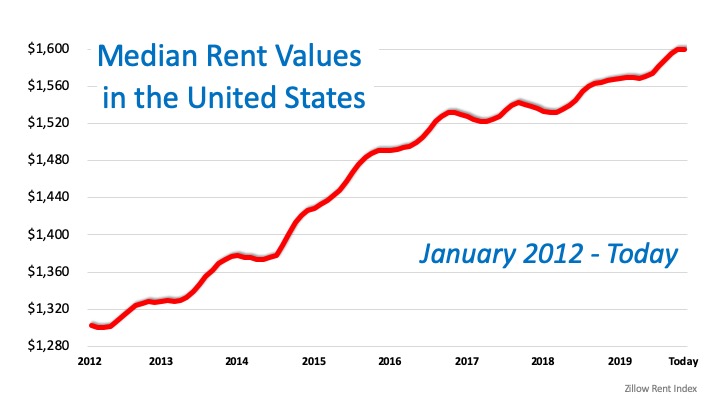

Is Good News Coming?
There seems, however, to be some good news on the horizon. Four of the major rent indices are all reporting that rents are finally beginning to stabilize in all rental categories:
1. The Zillow Rent Index, linked above, only rose 2.6% over the last year.
2. RENTCafé’s research team also analyzes rent data across the 260 largest cities in the United States. The data on average rents comes directly from competitively rented, large-scale, multi-family properties (50+ units in size). Their 2019 Year-End Rent Report shows only a 3% increase in rents from last year, the slowest annual rise over the past 17 months.
3. The CoreLogic Single Family Rent Index reports on single-family only rental listing data in the Multiple Listing Service. Their latest index shows how overall year-over-year rent price increases have slowed since February 2016, when they peaked at 4.2%. They have stabilized around 3% since early 2019.
4. The Apartment List National Rent Report uses median rent statistics for recent movers taken from the Census Bureau American Community Survey. The 2020 report reveals that the year-over-year growth rate of 1.6% matches the rate at this time last year; it is just ahead of the 1.5% rate from January 2016. They also explain how “the past five years also saw stretches of notably faster rent growth. Year-over-year rent growth stood at 2.6% in January 2018, and in January 2016 it was 3.3%, more than double the current rate.”
It seems tenants are getting a breather from the rapid rent increases that have plagued them for almost a decade.
Bottom Line
Rental expenses are beginning to moderate, and at the same time, average wages are increasing. That power combination may allow renters who dream of buying a home of their own an opportunity to save more money to put toward a down payment. That’s sensational news!
Wednesday, December 18, 2019
The Biggest Issue Facing Housing Next Year

This coming year the housing market will be defined by 3 things- inventory, interest rates, and appreciation. But the biggest issue the housing market will face in 2020 is an inventory shortage. There aren’t enough homes on the market for buyers, especially on the lower end of the market. This is a topic that has come up frequently within the past several months.
Based on what is forecasted, we know that interest rates are projected to remain low and that appreciation is expected to continue as we move into 2020. Additionally, the upcoming election will provoke many unique perspectives on the health of the US housing market. The challenge will be understanding what is actually happening and how you can best position yourself if you are thinking of buying or selling your home.
Here are several perspectives to consider on the inventory issue facing housing next year:
According to realtor.com:
“Despite increases in new construction, next year will once again fail to bring a solution to the inventory shortage that has plagued the housing market since 2015. Inventory could reach a historic low as a steady flow of demand, especially for entry level homes, and declining seller sentiment combine to keep a lid on sales transactions.”
Diana Olick at CNBC:
“Inventory has been falling annually for five straight months, after it recovered slightly toward the end of last year, due to a spike in mortgage rates. Rates began falling again by spring of this year. Homebuilders have been increasing production slowly, but it’s not enough to meet the increasingly strong demand.”
George Ratiu, Senior Economist with realtor.com
"As millennials -- the largest cohort of buyers in U.S. history -- embrace homeownership and take advantage of this year's unexpectedly low mortgage rates, demand is outstripping supply, causing inventory to vanish. The housing shortage is felt acutely at the entry-level of the market, where most millennials are looking to break into the market for their first home."
Bottom Line
The most important thing you can do is understand what is happening in your local market. You may not be able to avoid some of the issues brought on by low inventory, but you can be educated and prepared.
There aren’t enough homes on the market for buyers, especially on the lower end of the market. Contact us after New Year's if you have a house to sell! We'll work with you until closing!!
Subscribe to:
Posts (Atom)